BEHAVIORAL SIMULATION FOR PRODUCT TEAMS
🧠

Make confident product decisions before you ship

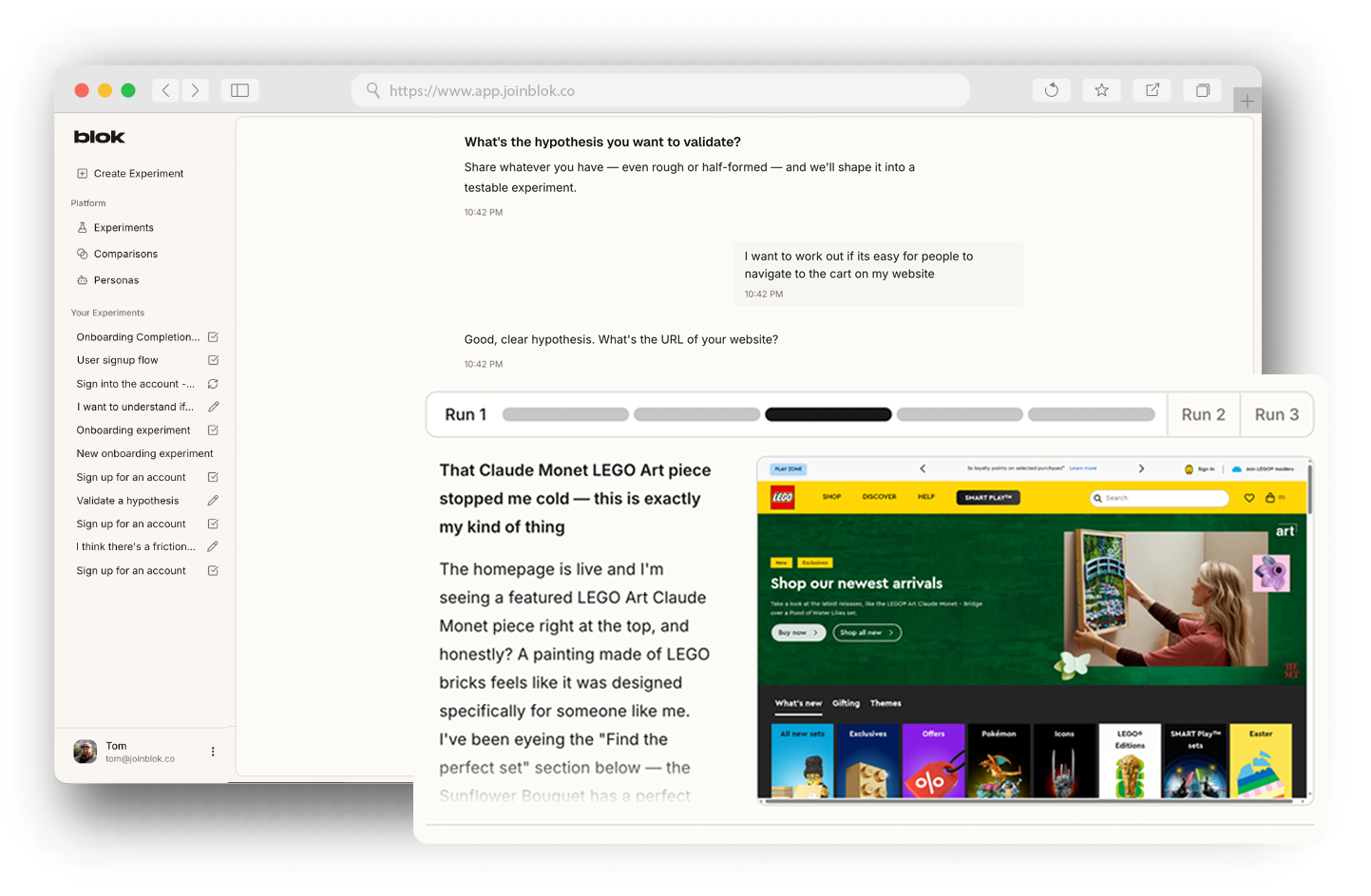
Blok models real user behavior from your product data and runs synthetic agents through flows and prototypes to predict friction, drop-off, and lift - in hours, not 6-week experiment cycles.

Build conviction before engineering begins.

Develop Conviction In The Problem
Product market fit is an ongoing process rather than a definite stage, focused on retention. And the goal is to develop conviction in the problem before building anything so that you don't waste any time or resources in the wrong areas to begin with.
Rohan
Product Lead
Finding Winning Ideas
We now have over 300 teams running tens of thousands of experiments annually. Experimentation is integral to the way we develop the Spotify experience — but it's a lot more than just running A/B tests to find the winning ideas, and we're looking for ways to test more quickly.
Sebastian
Senior Data Scientist
Validating Before Building
A way to validate, "Am I on the right track," is so important. It's a very common mistake, where it's been six months of just building in a hole, then you get out there and you start validating by trying to sell it. And if you've got some foundational assumptions wrong, you're in trouble
Barry
CEO
Understanding Users Better
Experimentation is what's given us a huge edge over some of our competitors. What your building gives product teams a way to move 10x quicker.
Danielle
Head of Growth
Focusing On The Right Areas
Experimentation is an incredible way to focus your valuable time in the right areas. Many organizations have implemented Agile, allowing them to deliver to market faster than ever before. This is all a waste of time if the delivered features don’t add value.
Evie
ex-Group Product Manager
Develop Conviction In The Problem
Product market fit is an ongoing process rather than a definite stage, focused on retention. And the goal is to develop conviction in the problem before building anything so that you don't waste any time or resources in the wrong areas to begin with.
Rohan
Product Lead
Finding Winning Ideas
We now have over 300 teams running tens of thousands of experiments annually. Experimentation is integral to the way we develop the Spotify experience — but it's a lot more than just running A/B tests to find the winning ideas, and we're looking for ways to test more quickly.
Sebastian
Senior Data Scientist
Validating Before Building
A way to validate, "Am I on the right track," is so important. It's a very common mistake, where it's been six months of just building in a hole, then you get out there and you start validating by trying to sell it. And if you've got some foundational assumptions wrong, you're in trouble
Barry
CEO
Understanding Users Better
The number of problems and unanswered questions that you have about your current and future users needs and behaviours just increases every single day. To truly understand them better, to really improve your product, you really need to make experimentation integral.
Danielle
Head of Growth
Focusing On The Right Areas
Experimentation is an incredible way to focus your valuable time in the right areas. Many organizations have implemented Agile, allowing them to deliver to market faster than ever before. This is all a waste of time if the delivered features don’t add value.
Evie
ex-Group Product Manager

BACKED BY PRODUCT LEADERS FROM LEADING TECHNOLOGY COMPANIES

BACKED BY PRODUCT LEADERS FROM

HOW IT WORKS

Decide what to ship before you build it

Start with a decision
You’re about to launch a new flow, redesign, or experiment - but don’t know how users will respond to the changes.
Simulate how users behave
Simulate how different users move through your product - with up to 87% behavioral fidelity to real-world outcomes.
Decide on changes before shipping
Understand what’s likely to impact outcomes, and move forward with confidence before anything goes live.
WHAT CAN I TEST
PRODUCT SIMULATION

See how users move through your product

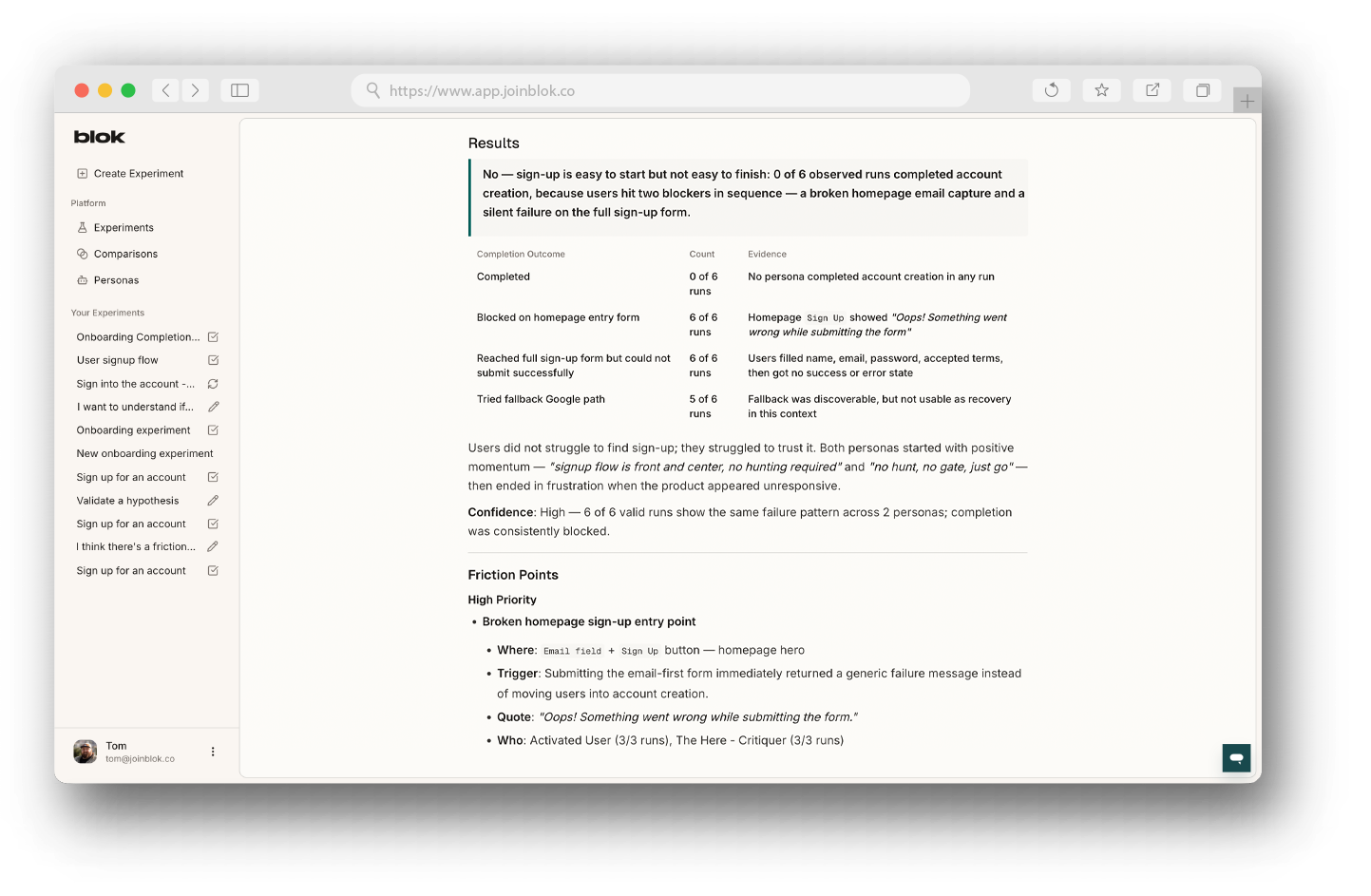
Simulate how different users progress through key flows - from onboarding to pricing - and identify where they hesitate, drop off, or behave differently before anything goes live to real users.

BOOK DEMO
WHY WE'RE DIFFERENT

Why teams use blok

CASE STUDIES
BEHAVIORAL INSIGHT

Understand what’s driving user decisions

Identify why users hesitate, what influences their behavior, and how different segments respond - so you can decide what to change before you ship.

BOOK DEMO
CORE EXPERIMENTS

What can you test before you ship?

BOOK DEMO
REAL WORLD RESULTS

How blok helps teams today

~87%
Behavioral Fidelity
Backtested on real user data and verified through evaluation runs - ensuring simulations reflect real behavior, not assumptions, so you can trust what to build before you ship.
HOW WE CALCULATE FIDELITY
FREQUENTLY ASKED QUESTIONS

How blok works with modern product teams

What is blok?

Blok helps product teams understand how users will behave in their product - before anything is shipped. It turns behavioral data into clear, testable decisions, reducing the risk of launching changes that don’t improve the target metric.

What do teams get from it?

Product teams see how users move through their product - where they hesitate, how different segments behave, and what to change. The result? Clearer decisions before anything goes live, reducing wasted engineering effort and avoiding costly iterations.

When should this be used?

It’s most useful at decision points - when evaluating a new flow, redesign, or experiment. Instead of committing time and resources and waiting for results, teams can explore outcomes in advance and move forward with greater confidence.

What kind of impact does this have on a team?

Product teams are able to evaluate decisions earlier, reducing the need to ship and iterate repeatedly. This shortens development cycles, lowers the cost of failed experiments, and helps teams focus engineering effort on changes that are more likely to perform.

How does it fit into an existing stack?

It sits between analytics and experimentation. Analytics shows what has happened, blok helps determine what to do next, and A/B testing validates the outcome in production. This reduces the number of experiments needed and improves the quality of what gets shipped.

How accurate are the simulations?

Simulations are validated against real-world experiments and achieve up to 87% behavioral fidelity. Because they are grounded in actual interaction data, they provide a reliable directional signal before committing resources.

How is this different from analytics or A/B testing?

Analytics explains past behavior, and A/B testing measures live outcomes after release. blok allows teams to evaluate decisions in advance, reducing the need to learn through production risk.

How does this differ from synthetic user research?

Synthetic research tools simulate what users might say. This focuses on what users do - how they interact with product flows, where they pause, and how decisions unfold step by step.

Is existing data required?

It performs best when connected to real behavioral data, as this improves fidelity. It can also be used earlier in the lifecycle to simulate new ideas before large-scale data is available.

Who is this designed for?

It’s designed for product teams operating at scale - including product managers, designers, researchers, and growth teams responsible for improving user journeys and making high-impact decisions.

Is it secure and enterprise-ready?

Yes. blok is designed for enterprise environments with strong data security practices and infrastructure. Enterprise teams can evaluate without production credentials, and customer data is isolated, access-controlled and GDPR-aligned. SOC2 audit in progress - documentation available on request.

See how your users behave before you ship

BOOK DEMO